Yes, 700W solar panel modules are ready for utility-scale projects. N-type TOPCon and HJT architectures, plus 210mm wafers, drive this shift. Readiness rests on three pillars: mature efficiency near 22.5%, balance-of-system savings, and real deployment data. This 700W Solar Panel Technology Explained analysis asks whether ultra high power solar module demand is durable or a temporary peak. Each high watt solar panel manufacturer now competes on bankability, tracker fit, and inverter matching.
Key Takeaways
-
700W solar panels use advanced N-type cells and larger wafers to reach about 22.5% efficiency.
-
These panels cut balance-of-system costs by 5-10% and improve energy output per dollar.
-
Check tracker compatibility and choose tier-1 manufacturers for reliable utility-scale projects.
700W Solar Panel Technology Explained: What Makes It Possible?
A 700W module delivers roughly 700 watts under standard test conditions. Industry-leading products reach about 22.5% efficiency at this power class. This 700W Solar Panel Technology Explained section covers the cell architectures and wafer formats behind that performance.
N-Type TOPCon and HJT Cells
Most current 700W and 750W modules use N-type TOPCon or HJT cells. Older PERC architectures cannot reach this power class. Cell-level efficiency for these N-type technologies ranges from 25.5% to 27%. Full module specifications land between 22% and 25% after accounting for packing losses.
|
Cell Technology / Context |
Efficiency Range |
|---|---|
|
N-Type TOPCon and HJT (700W+ modules) |
25.5%–27% |
|
Typical 700W solar panel specifications (N-Type TOPCon or HJT) |
22%–25% |
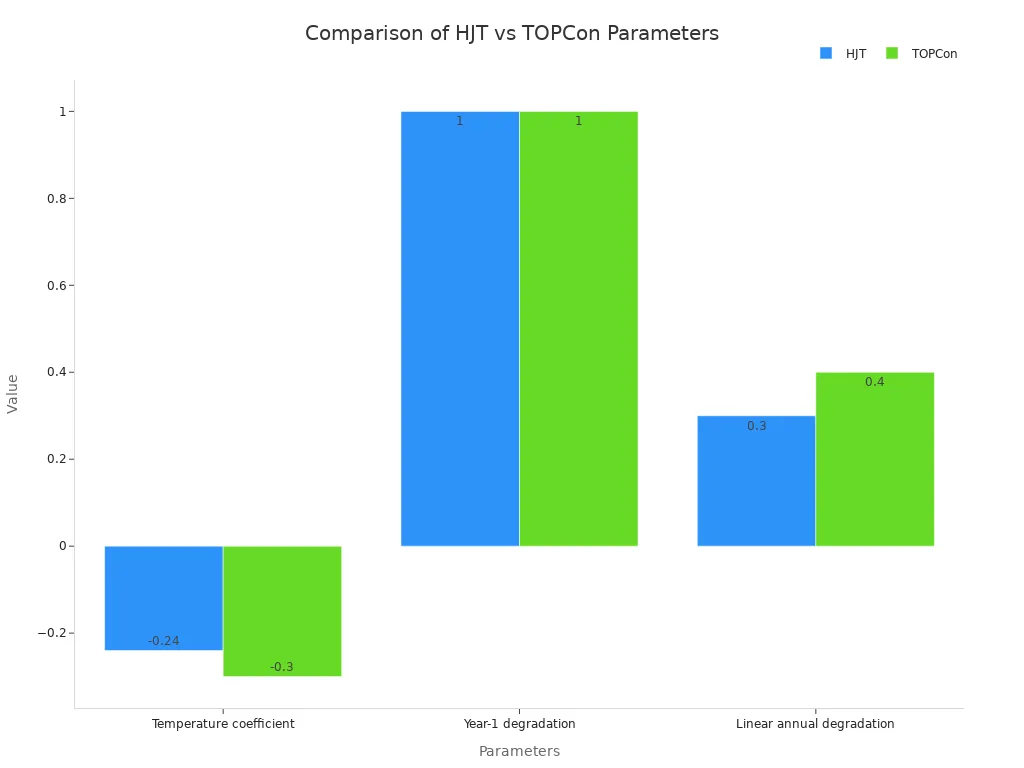
The two technologies differ in durability. HJT holds a temperature coefficient of −0.24%/°C. TOPCon sits at −0.30%/°C. Both lose about 1% in year one. HJT then degrades roughly 0.30% per year on a warranted basis, while TOPCon runs at 0.40% per year. N-type cells generally degrade slower than PERC, which carries 0.45%/year.
210mm Wafers and Higher Operating Currents
The 210mm wafer format unlocks the 700W power class. A 132-cell layout on this format provides the irradiated area and electrical conditions the module needs. A 700W solar panel typically operates at currents around 17–18 A.
|
Feature |
M10 (182mm sq.) |
G12 (210mm sq.) |
G12R (182×210mm) |
|---|---|---|---|
|
Wafer Area |
274 cm² |
440 cm² |
382 cm² |
|
Module Power (TOPCon) |
560–590 W |
670–720 W |
620–700 W |
|
Inverter Current Req. |
15–16A MPPT |
16A+ MPPT (essential) |
15–16A MPPT |
The G12R format captures the key benefit of G12 — the 210mm dimension delivering higher power per cell — while retaining the 182mm dimension that keeps module width at roughly 1,134mm. Higher power output per cell results from the larger active area. The passivated contact structure of TOPCon keeps losses relatively low under high-current conditions. PERC modules are more susceptible to series resistance and LID/PID effects at these currents.
Utility Benefits: BOS Savings and LCOE Gains

Project economics decide whether any module class reaches utility scale. A 700W solar panel changes the cost structure of a plant before a single megawatt-hour is sold. This section stays at the project level and leaves cell physics to the previous discussion.
Lower Balance-of-System Costs
Fewer modules per megawatt drive the savings. A 700W module needs roughly 30% fewer units than a 550W module to build the same array capacity. That reduction cascades through the entire bill of materials.
Typical balance-of-system savings land between 4% and 6% per megawatt. The gains come from three sources. Mounting hardware shrinks because fewer clamps, rails, and foundations are required. DC wiring drops because fewer strings need combiner runs. Labor hours fall because installers handle fewer pieces per megawatt.
A 100 MW project built with 700W modules instead of 550W modules avoids handling roughly 39,000 module units, with proportional reductions in clamps, connectors, and cable runs.
Sustainability claims reinforce the procurement case. Silicon PV panels generate 7.2x to 11.4x more energy than is required to produce them. Fewer modules per megawatt also mean less material shipped, mounted, and eventually recycled.
Improved LCOE and Inverter Matching
Higher operating currents improve inverter matching. A 700W solar panel runs at roughly 17–18 A, and G12-format products require 16A+ MPPT channels. That higher current lets a given inverter capacity support a larger DC-side array. Developers can raise the DC-to-AC ratio without adding inverter blocks. The result is better utilization of existing inverter hardware and a lower cost per kilowatt-hour.
The levelized cost of energy improves through both channels. Lower BOS spending reduces upfront capital cost. Better inverter utilization raises energy yield per dollar of power electronics. Together, these effects push LCOE down at the plant level.
Supply-side competition matters here too. Every high watt solar panel manufacturer now scales TOPCon and HJT lines, and that capacity pressure steadily narrows the price gap between 700W and 550W products. An ultra high power solar module therefore competes on total installed cost, not on nameplate wattage alone. Developers should model BOS savings and inverter matching together, because the two effects compound across a full utility-scale build.
700W vs. 550W/600W Modules: A Data Comparison
Efficiency, Degradation, and Temperature Coefficients
The efficiency gap between module classes is measurable. A 700W solar panel reaches roughly 22.5% efficiency. Mainstream 550W and 600W products sit between 20.4% and 21%. The 400W utility-scale baseline, long the incumbent reference point, also lands near 20.4%. That spread means a 700W module converts more of the same sunlight into usable power within an identical footprint.
|
Metric |
700W Class |
550W/600W Class |
400W Baseline |
|---|---|---|---|
|
Module efficiency |
~22.5% |
20.4%–21% |
~20.4% |
|
Annual degradation |
0.30%–0.40% |
~0.45% (PERC) |
~0.45% (PERC) |
|
Temperature coefficient |
−0.24% to −0.30%/°C |
~−0.35%/°C |
~−0.35%/°C |
Degradation and temperature behavior favor the higher power class. N-type cells lose 0.30% to 0.40% per year, while PERC products degrade at roughly 0.45% per year. HJT holds a temperature coefficient of −0.24%/°C and TOPCon sits at −0.30%/°C. Older PERC modules run near −0.35%/°C. Hot sites therefore retain more output with N-type products.
Cost per Watt and BOS Impact
Cost per watt narrows as production scales. Every high watt solar panel manufacturer now runs TOPCon and HJT lines, and that capacity pressure compresses the premium once attached to 700W products. The larger economic effect sits in balance-of-system spending. A 700W module needs roughly 30% fewer units per megawatt than a 550W module, which cuts clamps, rails, connectors, and cable runs. Typical BOS savings land between 4% and 6% per megawatt. An ultra high power solar module thus competes on total installed cost rather than nameplate wattage alone.
Real-World Deployment and Applications
Utility-Scale, C&I, and Agricultural Use Cases
Deployment data now covers all three major segments. Utility-scale farms form the largest share, where the ultra high power solar module class supports multi-hundred-megawatt builds. Commercial and industrial rooftops and ground mounts follow, because these sites need large-scale power generation within limited footprints. Agricultural operations represent a growing third category. Farms pair 700W arrays with irrigation pumps, grain drying systems, and cold storage. The high power density reduces the number of mounting points across barn roofs and field racks.
Tracker Compatibility and Installation Considerations
Trackers rated for 550W–600W modules may need review before accepting 700W products. Higher operating current pushes against the limits of module-level junction boxes and bypass diodes. It also raises resistive losses and thermal loading, which requires heavier conductors, thicker DC cables, and higher-rated DC components. Equipment options narrow, and late-stage substitutions become more likely.
Mechanical loads demand equal attention. Longer and wider modules alter load distribution across tracker rows under wind and snow. Bending moments shift at mounting points and frames. Reinforced frames or structural upgrades may be necessary, and heavier assemblies need different handling and lifting plans.
|
Issue Category |
Specific Compatibility Impact |
|---|---|
|
Higher Current |
Pushes junction box and bypass diode limits; requires heavier conductors and higher-rated DC components |
|
Mechanical Loads |
Alters load distribution; shifts bending moments; may require reinforced frames or structural upgrades |
|
Tracker Margins |
Performance margins narrow as modules extend beyond familiar envelopes |
Mechanical penalties tend to accumulate quickly once dimensions push beyond established norms. Formats that remain closer to familiar envelopes generally simplify engineering review and reduce uncertainty as projects move from design into construction.
Choosing the Right Ultra-High-Power Module
Bankability and Supply Chain Maturity
Module selection starts with the supplier, not the datasheet. A high watt solar panel manufacturer with tier-1 status carries the financial weight that lenders and insurers require. Tier-1 firms are vertically integrated, produce their own wafers, cells, and modules, and hold at least five years of operational history. Tier-2 assemblers buy cells from other suppliers. Tier-3 firms lack vertical integration and carry less than two years of history. Tier-1 panels typically cost 10–20% more, yet they deliver stronger warranty support and long-term reliability.
|
Criterion |
What to Check |
Minimum Standard |
|---|---|---|
|
Bankability |
Bloomberg Tier 1 status, financial health |
Tier 1 (Bloomberg NEF) |
|
Module efficiency |
Nameplate efficiency vs. area |
≥21.5% (N-type TOPCon) |
|
Warranty terms |
Product and performance warranty |
25yr product / 30yr performance |
|
Temperature coefficient |
Power loss per °C above 25°C |
≤−0.30%/°C |
|
Certifications |
IEC 61215, IEC 61730, UL 61730 |
All required for your market |
|
Local service |
Local office, warranty claim process |
Within 48hr response time |
The gap between a laboratory record and a bankable product is enormous. Scaling production demands uniform coating across millions of square meters, consistent quality control, and a supply chain for materials that barely existed two years ago. Investors require 25-year performance warranties and insurers willing to back the technology. That is why the solar industry adopts breakthrough designs slowly.
Matching Technology to Project Conditions
Site conditions decide which module class fits. High-temperature sites favor HJT, which holds a temperature coefficient of −0.24%/°C, while TOPCon sits at −0.30%/°C. Low-irradiance sites benefit from N-type low-light performance. Tracker configurations need review, because higher currents push junction box and bypass diode limits.
Developers should determine required DC capacity first, then compare module dimensions and efficiency relative to area. Limited space favors higher power density. Commercial rooftops favor the 700W class, which handles more easily than larger formats.
The efficiency trajectory continues beyond 700W. Perovskite-silicon tandem cells have exceeded 30% in the laboratory, opening a commercialization pathway toward higher-efficiency solar cells. The Shockley-Queisser limit sets a theoretical ceiling near 33% for single-junction cells, so 700W represents one step on a longer curve.
700W solar panel modules are mature and economically compelling for utility projects, yet they are not a universal drop-in replacement. Tracker ratings, site conditions, and financing terms determine the best choice. N-type TOPCon and HJT efficiency near 22.5%, 4–6% BOS savings, and improved inverter matching support deployment. Perovskite tandem cells exceeding 30% in the lab signal continued gains, but 700W remains the current sweet spot. Developers should pilot ultra high power solar module units on suitable projects, validate performance data, and scale as supply chain confidence grows.
FAQ
Are 700W modules compatible with existing trackers?
Not always. Trackers rated for 550W–600W modules may need review. Higher currents push junction box and bypass diode limits, and longer frames shift mechanical loads.
Do 700W modules cost more per watt?
The premium is narrowing. Every high watt solar panel manufacturer now scales TOPCon and HJT lines. A 700W solar panel competes on total installed cost, not nameplate wattage.
Is 700W the final efficiency ceiling?
No. Perovskite-silicon tandem cells have exceeded 30% in the laboratory, with a pathway toward higher efficiency. The Shockley-Queisser limit near 33% still caps single-junction silicon. An ultra high power solar module remains one step on that curve.